Starling Lab
A website that has to earn the trust it argues for — built for the first academic centre proving what is authentic, in an era when generative AI can fabricate anything convincingly.
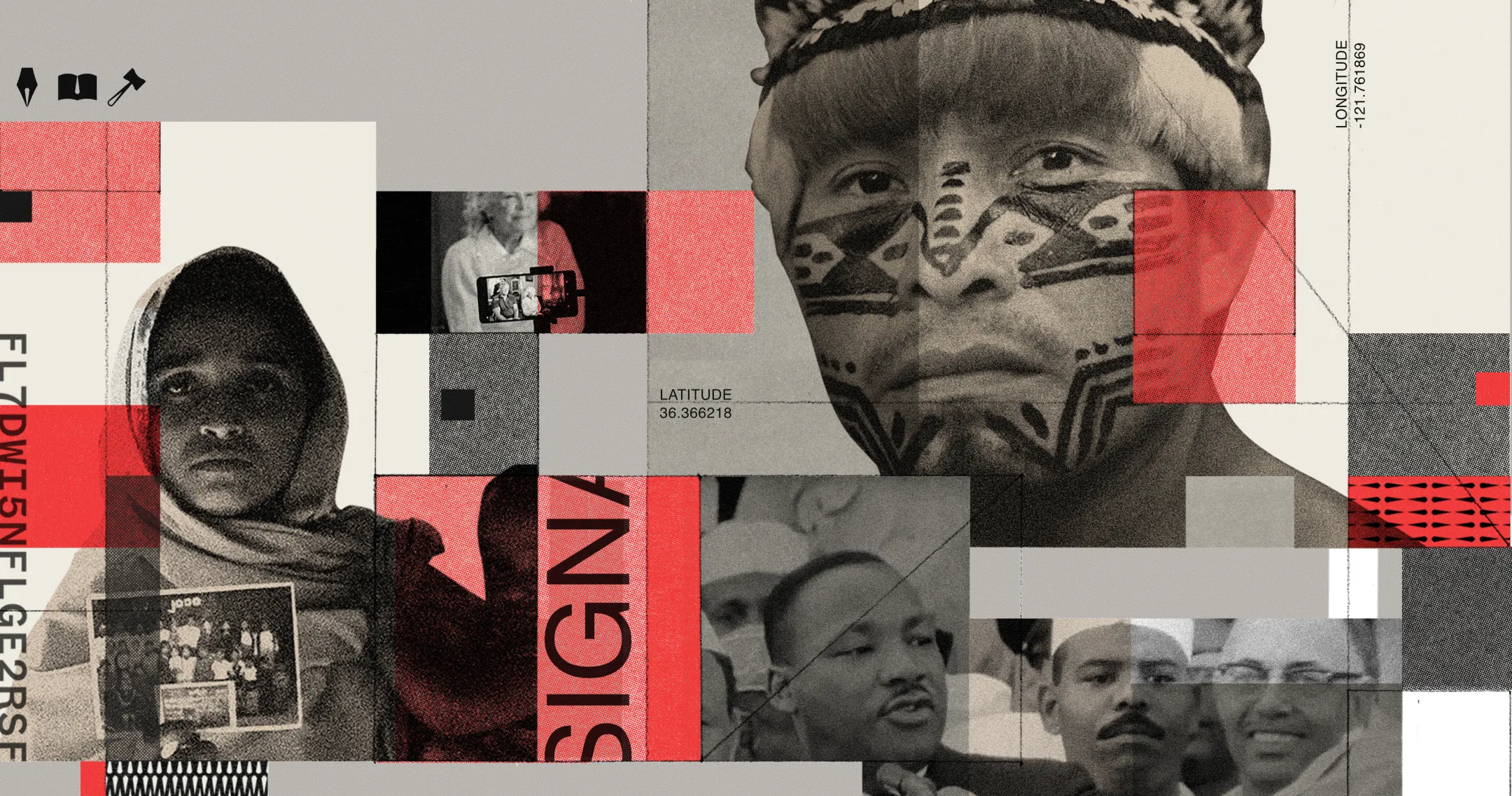
Background
Starling Lab for Data Integrity is the first academic centre dedicated to using decentralised web technology to establish trust in digital records. A joint initiative of Stanford University and the USC Shoah Foundation, its work runs across journalism, history, law and spatial media – building the first cryptographic archive used in a war crimes investigation, documenting bombed Ukrainian schools for submission to the ICC, preserving Holocaust survivor testimony, and putting a verifiable photo newswire into production with Reuters and Canon.
That work has become essential. Generative AI produced fifteen billion images in eighteen months. Photography took 149 years to reach the same number. When anything can be fabricated convincingly, the useful question is no longer whether something looks real. It’s whether its origin can be proven – and Starling is the institution built to answer it.
Working from brand and design concepts developed by Pentagram and Gladeye, we designed and built the site: the design system, the architecture, every template and component, and a WordPress platform a research team could run without a developer. We worked directly with the Starling team throughout, through to launch in 2026. This is the kind of agency partnership we do well.

The site has to earn the trust it argues for
An organisation whose entire proposition is the authenticity of digital records can’t afford a website that feels approximate. Every detail is read, fairly or not, as evidence of whether the Lab knows what it’s doing – and the Lab is read by the ICC, the UN Human Rights Council, Reuters, CNN and Stanford.
That set the bar, and it ruled out the obvious shortcut. The client required Uncode. On a project like this it’s tempting to configure the theme and dress it. The pieces that carry the argument – the hero, the framework panels, the data integrity sequence, the editorial components – are custom modules instead, designed and coded on Uncode and pushed to the theme’s absolute limits, with everything else deferring to them.
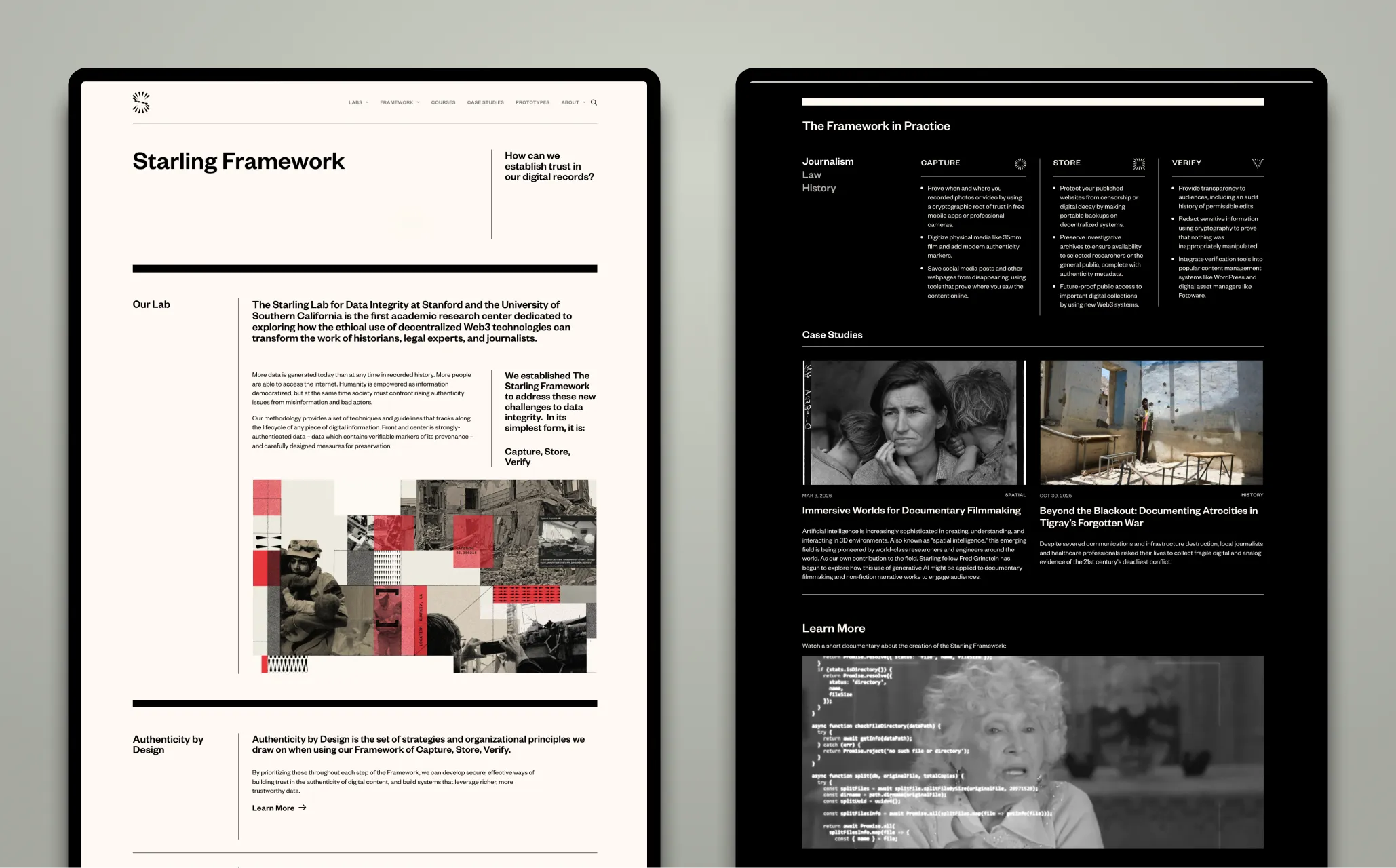
A system for the whole organisation
Starling is not one thing. It runs multiple labs, each with its own research programme – Journalism Fellowships, the Archive Accelerator, Project Dokaz – alongside a case study library, dispatches, courses, open-source prototypes, press highlights, events and recruitment. All of it had to feel like one organisation without flattening into one shape.
We worked the system out with the Lab rather than in isolation, dissecting each piece and assembling it as the build evolved, so decisions were made by the people who understood what the content had to do. It’s slower than working to a finished spec. It’s also how the pages that weren’t in the concept designs end up looking like they were designed on purpose.
The proof came later, when the Lab added a new practice area. The Spatial Lab arrived with its own programme, its own research questions and its own case studies, and it dropped into the existing system – templates, navigation, archive filters and all – without a redesign. A design system is only worth the name when it survives something it wasn’t drawn for.
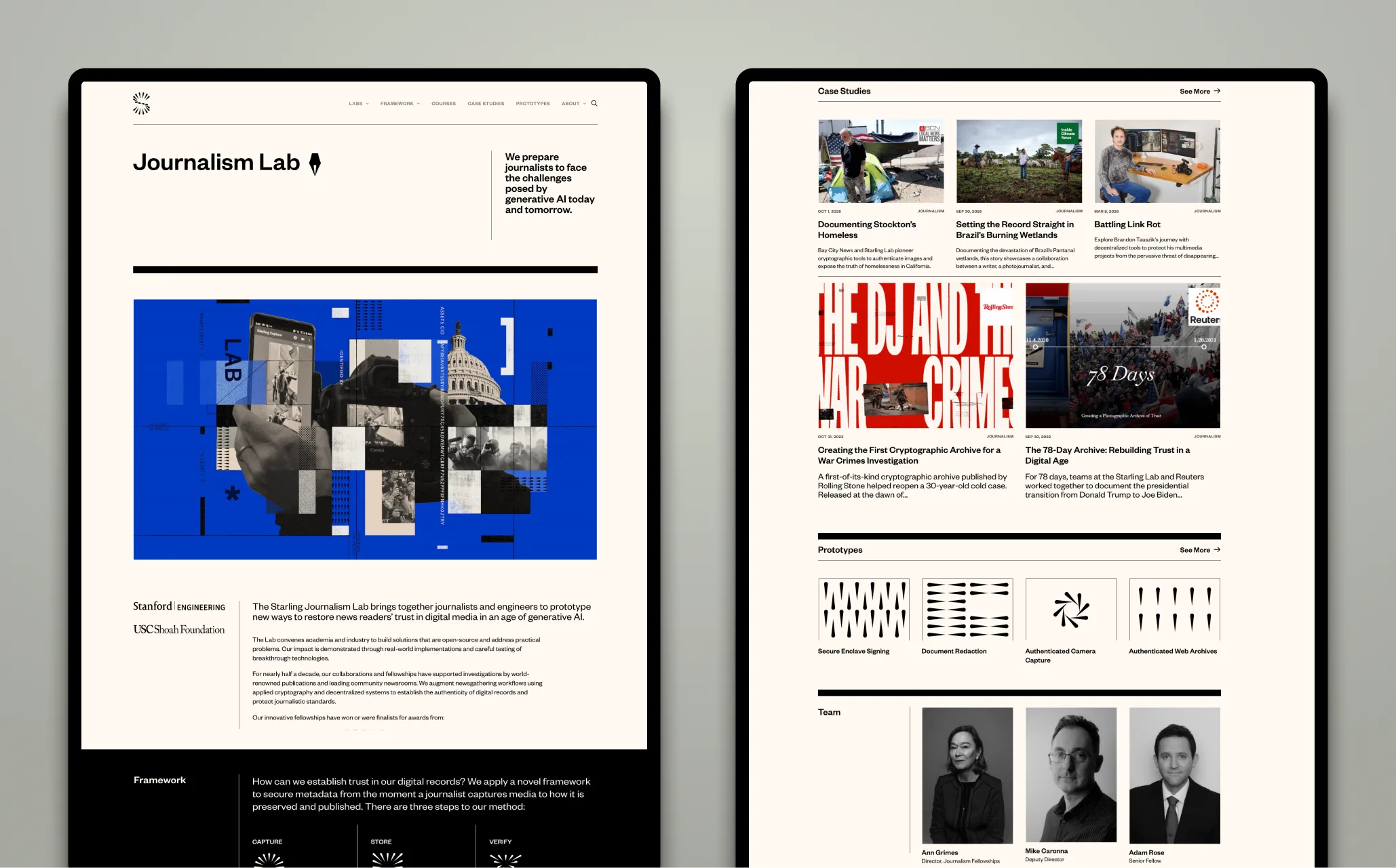
Making the argument move
The Lab’s central argument is a comparison: 149 years for photography to produce fifteen billion images, eighteen months for generative AI to do the same. Everything the organisation does follows from it.
Working from supplied artwork, we made it perform – adding the animation and film, and building it as a pinned scroll sequence where the figures resolve out of blur as the comparison assembles, so the reader feels the gap between the two numbers rather than reading it.
Then rebuilding its behaviour for mobile. A pinned scroll narrative designed at desktop width doesn’t survive a 375px screen by scaling down; the pacing, the crops and the reveal order all have to be reconsidered. Most of the effort in that component went into the version most people will actually see.
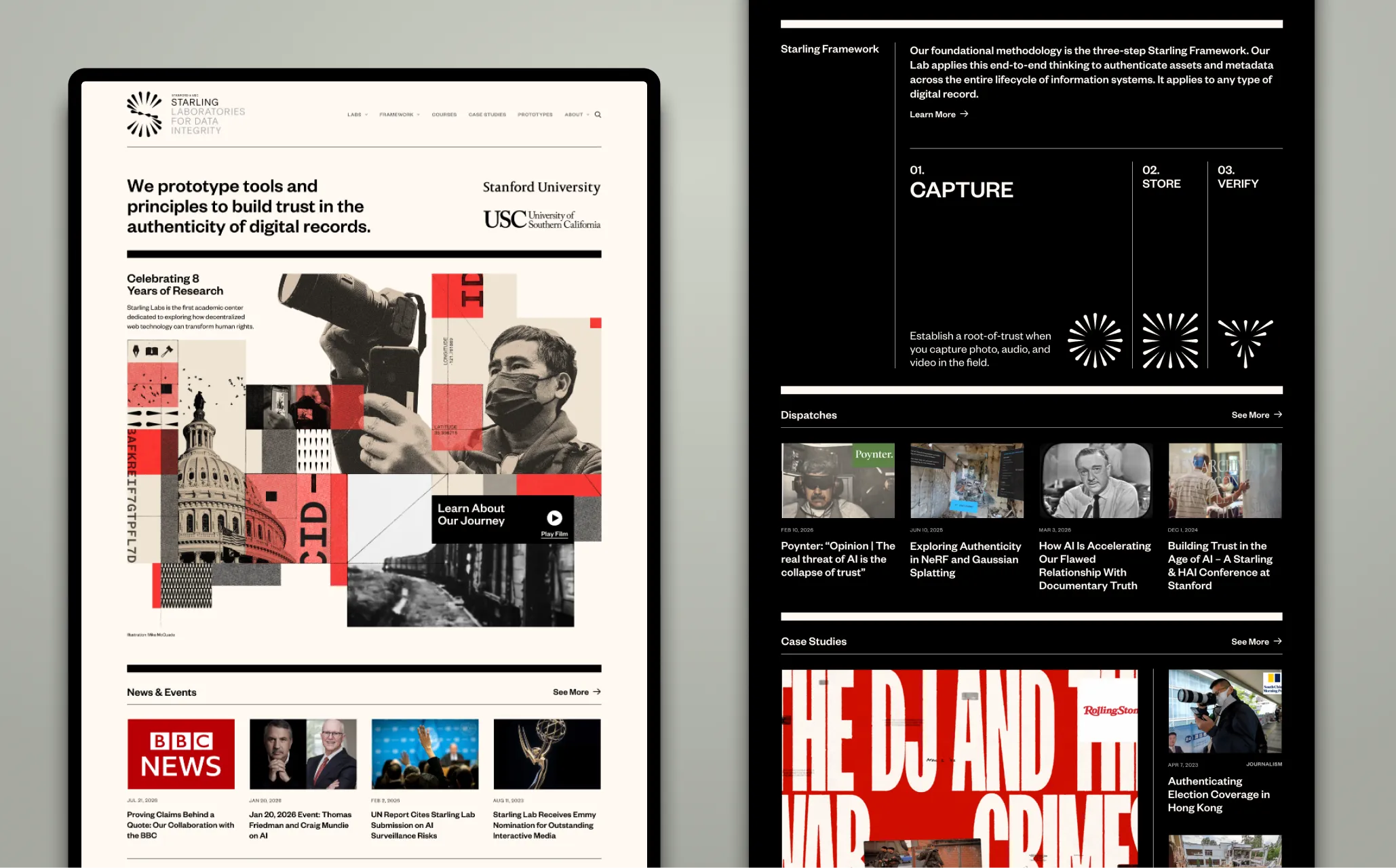
A single place to publish
The site’s job was to become the centre of the Lab’s publishing – one place where research, submissions, fellowships and collaborations sit together and read as a body of work.
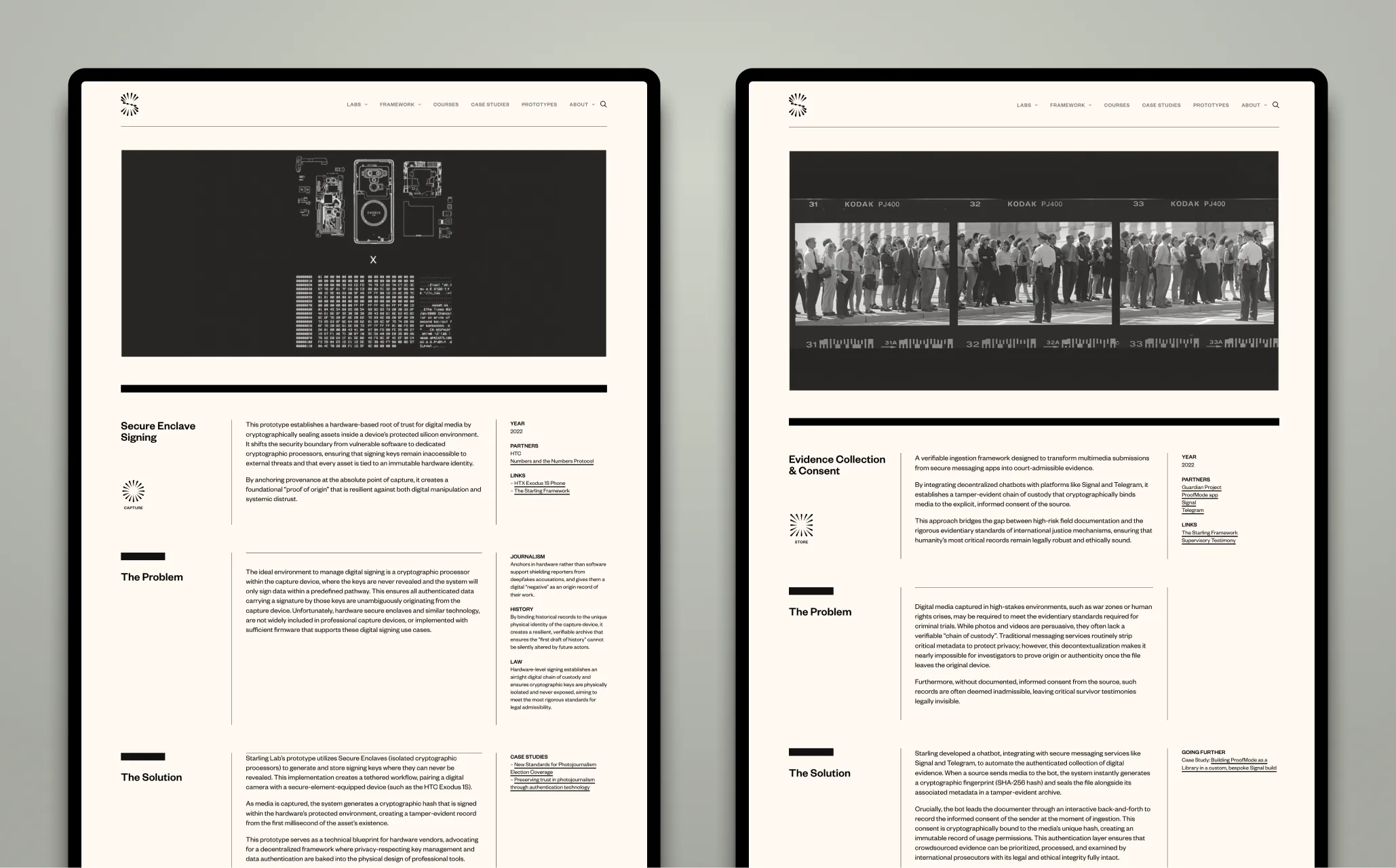
The Lab asked for four ways of surfacing case studies on a single page: featured work by practice area, an Editor’s Pick with room for a proper standfirst, the most recent studies, and a filterable archive across every area with a live count. Four curation mechanisms competing for one page is where a design usually turns into a list.
Making them coexist was the design problem: giving each a different weight, rhythm and density so a reader moves between them without noticing the machinery. Underneath, the content model separates the types properly – case studies, dispatches, news and events, prototypes, courses, people – and relates them, so a case study surfaces alongside the lab that produced it and the framework it applies. Editors file a piece of work once. The site does the cross-referencing.
Built for a team without developers
WordPress — and Uncode — was the Lab’s own call. As an academic organisation it wanted a platform its people already knew and could still hire for in five years, with no dependency on a specialist stack or a single agency. Given staff turnover, grant cycles and an editorial operation run by people whose expertise is cryptography and human rights law, it’s a defensible decision.
Our job was to make sure it cost them nothing. We build across Next.js, Sanity, Webflow and WordPress, and the platform is a project decision rather than a house preference – which means it can be the client’s decision without the work suffering for it.
Page composition is component-based and deliberately constrained. Administrators assemble pages from blocks that can’t be arranged into something off-brand. It’s a trade – less freedom in exchange for less drift – and for an organisation whose credibility is the asset, it’s the right side of the trade.
The work behind the work
Starling Lab is building the tools that let historians, journalists and lawyers prove what’s true in an era where proof has become the scarce thing. A website is a small part of that. But it’s the part where most people meet the argument first, and it either carries the authority of the work behind it or quietly undermines it.
Getting that right meant design and build treated as one job rather than two – which is how we work on everything.
To be trusted with the surface most people meet first, on work whose purpose is proving what’s true, is a rare brief and one we’re truely proud to have been part of.
Have an upcoming project, or need help with an existing one?